
A Practical Guide to Air Knife Selection for Industrial Drying, Cleaning and Blow-Off
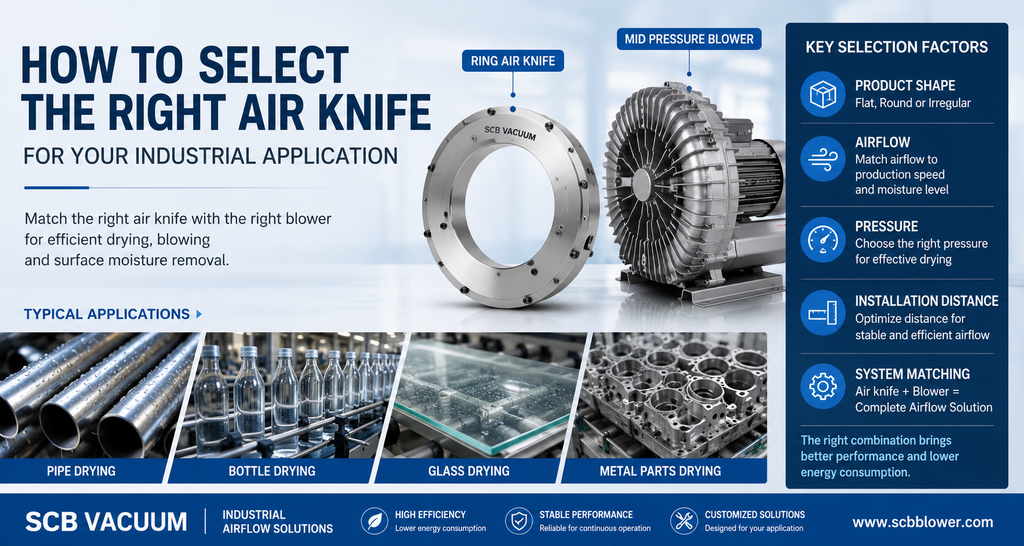
Choosing the right Air Knife is important for achieving effective industrial drying, water removal, cleaning, cooling, and blow-off performance. The correct Air Knife Selection depends on your product, production speed, conveyor width, airflow requirements, and installation conditions.
This guide explains the key factors to consider when selecting an Industrial Air Knife for your production line.
What Is an Air Knife?
An Air Knife is a device that produces a controlled, continuous air stream across a product or surface. It is commonly used for industrial drying, water removal, dust removal, cleaning, cooling, and blow-off applications.
An Air Knife can be used with different air sources depending on the application. For industrial production lines, the Air Knife and its air source should be considered as a complete airflow system.
1. Identify Your Application
The first step in Air Knife Selection is to define what you need the airflow to do.
For industrial drying, the main purpose may be removing water or moisture from a product surface. For cleaning applications, the Air Knife can remove dust, particles, or debris.
Common applications include:
- Conveyor drying
- Water removal
- Product drying
- Surface cleaning
- Dust removal
- Cooling
- Industrial blow-off
Knowing the application helps determine the required airflow direction, coverage, and installation position.
2. Consider Product Size and Shape
Product size is one of the most important factors when choosing an Air Knife.
A narrow product may only require a short Air Knife, while a wide conveyor may require a longer Air Knife or multiple units.
Product shape is also important. Flat metal parts, bottles, containers, glass, and other products may require different airflow arrangements.
For products with complex surfaces, multiple Air Knives can be positioned at different angles to improve airflow coverage.
3. Check Conveyor Width
For conveyor drying, the Air Knife should provide sufficient airflow across the required working width.
Measure the actual product width and conveyor width before selecting the Air Knife. The installation position should also be considered to make sure the airflow reaches the target surface effectively.
For wider production lines, several Air Knives can be combined to provide wider or multi-directional airflow coverage.
4. Consider Production Speed
Production speed directly affects Air Knife performance.
When products move quickly through a production line, there is less time available for drying or blow-off. The Air Knife system therefore needs to provide suitable airflow for the production speed.
For high-speed applications, the number, position, and airflow direction of the Air Knives may need to be adjusted according to the actual process.
5. Check Airflow and Pressure
Airflow and pressure are key factors in an effective Air Knife Solution.
The required performance depends on what you need to remove and how quickly the product is moving.
For example, water removal from a fast-moving product may require a different airflow level from light dust removal.
The available air source should also be checked. Depending on the system, an Air Knife may be supplied by a blower or compressed air.
The Air Knife and air source should be properly matched to achieve the required airflow performance.
6. Consider Installation Position
Installation space can affect the final Air Knife Selection.
An Air Knife may be installed above, below, beside, or at an angle to the production line, depending on the application.
For example, top-mounted Air Knives can be used for surface drying, while additional Air Knives may be installed below a conveyor when both sides of a product need to be dried.
The distance between the Air Knife and product should also be considered during installation.
7. Do You Need One or Multiple Air Knives?
A single Air Knife may be suitable for simple blow-off applications.
However, more complex applications may require multiple Air Knives. This can be useful when products have multiple surfaces, when airflow needs to come from different directions, or when a wide conveyor requires greater coverage.
For example, a conveyor drying system may use Air Knives above and below the product to improve overall water removal.
8. Match the Air Knife With the Air Source
An Air Knife should not be selected separately from the air source.
A suitable Air Knife and blower system needs to provide the required airflow and pressure for the application. If the air source is not properly matched, the system may not achieve the expected drying or blow-off effect.
SCB can evaluate the Air Knife, air source, product, and installation conditions together when selecting an industrial airflow solution.
9. Air Knife Selection Checklist
Before contacting a supplier, prepare the following information:
- Product type
- Product size and shape
- Conveyor width
- Production speed
- Drying or blow-off requirement
- Required airflow direction
- Installation position
- Available air source
- Working environment
Providing this information makes it easier to determine a suitable Industrial Air Knife and airflow configuration.
Need Help Choosing an Air Knife?
There is no single Air Knife that is suitable for every application.
The right Air Knife Solution depends on the product, production line, airflow requirements, installation conditions, and available air source.
If you are looking for an Air Knife for industrial drying, conveyor drying, water removal, cleaning, cooling, or blow-off, SCB Vacuum Tech Limited can help evaluate your application and recommend a suitable solution.
Send us your application details, product size, conveyor width, production speed, and available air source.
SCB VACUUM — Air Knife Solutions for Industrial Drying, Cleaning and Blow-Off.
Working on a blow-off, drying or cooling problem?
Send us your application details and our engineers will recommend a system and give you a quotation within one working day.